

What is the principle of throttle orifice plate? What is the function?
Classification:
Release Time:2020-12-16
When the pressure difference between the front and back of the pipeline is large, the method of increasing the orifice plate is often used. The principle is: when the fluid flows in the pipeline, the pressure of the fluid is reduced and the energy is lost due to the local resistance of the orifice plate. This phenomenon is thermodynamically known as throttling. This method is simpler than the control valve, but it must be selected correctly, otherwise, the liquid is prone to cavitation and affects the safe operation of the pipeline.
When the pressure difference between the front and back of the pipeline is large, it is often increased.Throttle orifice plateThe principle is: when the fluid flows in the pipeline, the pressure of the fluid is reduced and the energy is lost due to the local resistance of the orifice plate. This phenomenon is called throttling in thermodynamics. This method is simpler than the control valve, but it must be selected correctly, otherwise, the liquid is prone to cavitation and affects the safe operation of the pipeline.
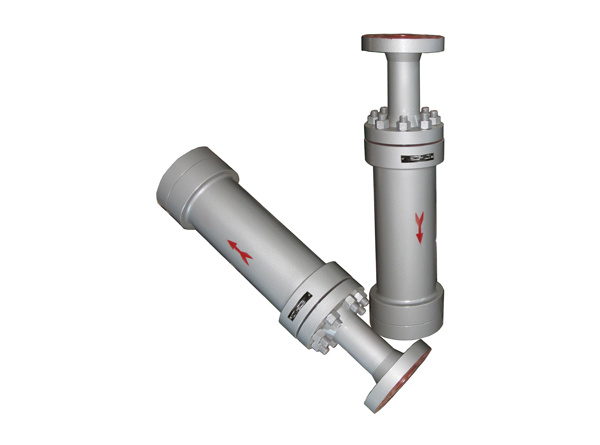
Environmental protection noise reduction type throttle orifice plate? utility model patent number: 201620766324.0
The function of the orifice plate is to make the aperture of the pipe smaller. When the liquid passes through the constriction, the flow beam becomes thinner or narrower. The minimum flow section downstream of the actual necking is called the reduced flow section. The flow velocity of the contraction section is the largest in the contraction section, and the pressure of the contraction section decreases significantly with the increase of the velocity of the contraction section. As the flow expands to a larger area, the velocity decreases and the pressure increases, but the downstream pressure does not fully recover to the upstream pressure, which is the result of internal turbulence and increased energy consumption. When the pressure pvc on the shrink section drops below the saturated steam pressure pv at the corresponding temperature of the liquid, the steam and the gas dissolved in the water will escape in the stream, forming a small bubble, and the lower the pressure, the greater the bubble. If the pressure downstream of the orifice plate is still lower than the saturated vapor pressure of the liquid, bubbles will continue to be generated in the downstream pipeline, and the two phases of liquid and vapor will be mixed, that is, flash evaporation will occur. When the downstream pressure is restored to be higher than the saturated vapor pressure of the liquid, the bubble quickly condenses and breaks under high pressure. At the moment of bubble rupture, a local cavity is generated, and the high-pressure water flows to the space occupied by the original bubble at a very high speed, thus forming an impact force. Because the gas and steam in the bubble is too late to completely dissolve and condense in an instant, it is decomposed into small bubbles under the action of the impact force, and then compressed and condensed by high-pressure water, which forms multiple repetitions and produces a noise. This phenomenon is called Bubble. Under the action of water hammer pressure, the surface of the runner material is fatigued and severely damaged. The whole process of bubble formation, development and collapse is called "cavitation" phenomenon, that is, the destruction of materials.
The above is for you to introduceThrottle orifice plateThe principle and function of, I hope to help you!
Related News
2026/02/28

Contact Information
+86 27-8970 8339
Address: No.5, Zhengjie, Shuangliu Street, Xinzhou District, Wuhan City, Hubei Province